
In today’s writing, we aim to identify the concepts of customer satisfaction and perceived value in the current business environment. One of my favorite foundational phrases, “perception is reality,” is usually the best starting point to explain how customers perceive your products and services. Even though organizations are working towards achieving customer satisfaction standards, one vital factor that is generally not given much attention is the perceived value. Although these two concepts are related, they have different features, and their combination should be approached with caution to achieve the company’s business growth and the loyalty of customers in the long run.
The distinction between customer satisfaction and perceived value:
Satisfaction is a concept widely understood as a comparison of the perceived performance of a product or service and the expected performance. It is a response to a particular incident that may be determined by the quality of the product or service, the manner of delivery and/or the post sale service received. However, customer satisfaction is not enough to ensure customers’ retention or advocacy for the brand. Satisfied customers can still migrate to another company if they think that they get more value from the competitor.
Perceived value, however, is a more complex concept which defines the customer’s perceived worth of the benefits of a product or service in relation to the price. Such perception is often very personal and may be informed by factors that are not necessarily directly related to the transactional process including brand equity, affective attachment or market alternatives.
In simpler terms, customer satisfaction says, “Did the product satisfy the customer?” whereas perceived value question is, ‘Was it worth it?’
Perception is Reality
This is a great starting point that comes in to play when it comes to understanding perceived value. In the modern world of social networks and fast information, the perception of your product in the market can be more important than the product itself. People make up their minds based on what they have personally encountered, what others have experienced, and, more and more, on how your company interacts with them.
Consider this: two companies may sell products that are very similar, but one company may be able to generate more value perception through better branding, customer relationship, and marketing. Consequently, the customer will believe that brand as providing more utility even if the product performance is the same.
Perception then shifts to be a key determinant of the actions of customers and companies need to be careful in managing the perception that the customers have about them. This is why a holistic approach to customer relationships is crucial: It is not enough that a product performs its intended function; the customer must also feel that he is receiving something extra.
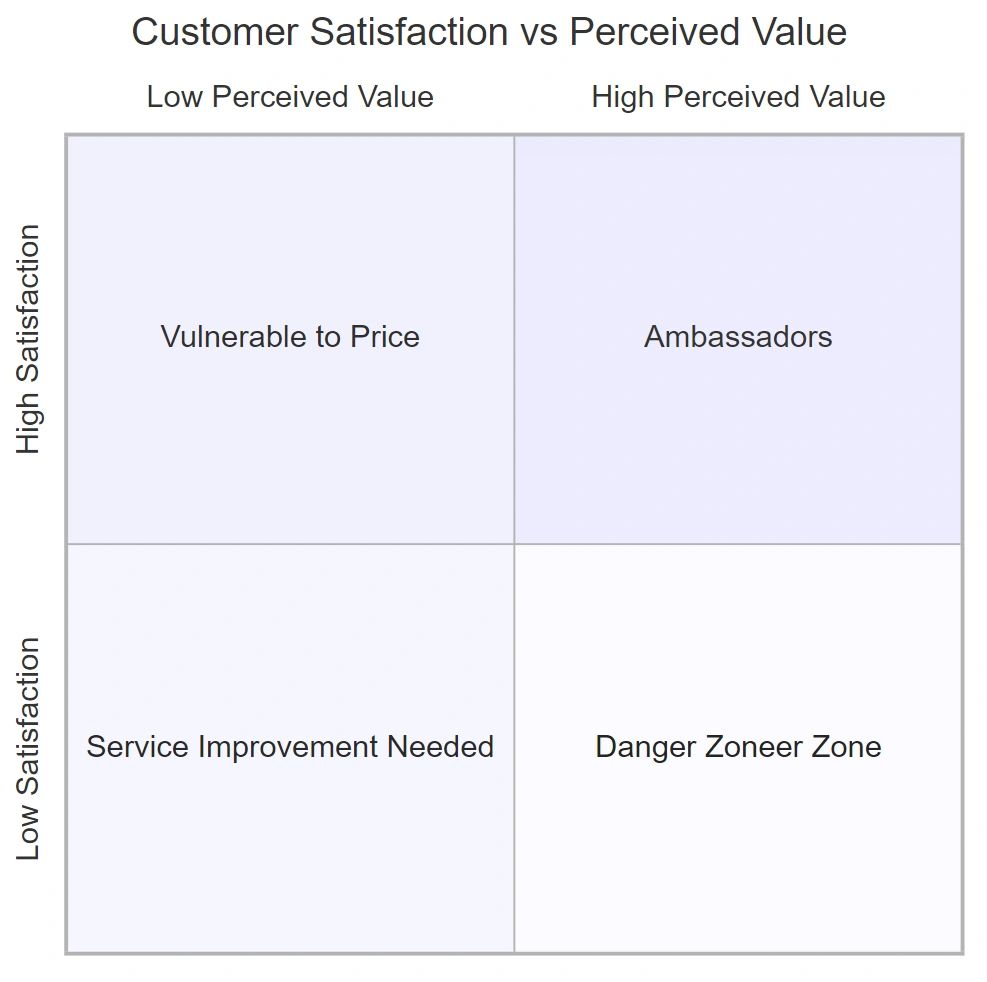
Matrix of Perceived Value vs. Customer Satisfaction
For a clearer picture of the relationship between perceived value and customer satisfaction, it may be helpful to turn to a model such as that which John Graham designed. The matrix presents a grid where perceived value and customer satisfaction are plotted along two axes:
High Satisfaction, High Perceived Value: This is the perfect quadrant because the customers are both loyal to the product/service and believe that they got their money’s worth. These customers are your ambassadors—they are likely to speak on behalf of your business and will continue to do so in the future.
High Satisfaction, Low Perceived Value: In this case, the customer is happy with the product but doesn’t think that it was worth the money spent. Such customers may not be dissatisfied, or unhappy with the product or service provided, but they are vulnerable to switching over to a competitor who is offering the same quality at a cheaper price. There are two things that companies need to do, first, try to change either the price or the features that make the product or service appear to be more valuable without having to raise the price.
Low Satisfaction, High Perceived Value: It happens when the customers may have liked the price of the product or the features it offers but for one reason or the other may have felt that they had a poor experience with the company; be it bad delivery, poor customer service or inconsistency in quality. Some of these customers are still retrievable and the only thing that may be needed to make them belong to the top right quadrant is an enhancement in customer service or consistency.
Low Satisfaction, Low Perceived Value: This is the danger zone. Customers in this segment are dissatisfied with the product, and also think that the product is overpriced. This group is likely to provide a negative feedback and defect towards other providers. Here, it’s necessary to take action and address their concerns and take time to reconsider the product or price once again.
Contemporary Importance of Perceived Value
Value in today’s society does not stop at the product level and can be seen as multifaceted. Today’s consumers want brands that resonate with them and their beliefs, this could be the environment, social issues, or the ability to be informed. Similarly, the ability to find information about products and customer reviews requires that companies fully engage in the management of their public image.
The Use of Value in Enhancing the Customer Relationship
Business owners and CEOs should know that, in order to attain sustainable success, it is important to offer high levels of customer satisfaction as well as high levels of perceived value. This means that, the company has to place a lot of emphasis on the price, quality, service and the brand equity. Although customer satisfaction is normally a question of eliminating certain pain points, value is a more general issue which can involve everything from pricing to communication.
Understanding what causes your customers to perceive value is key to building powerful relationships and increased customer loyalty, even in extremely crowded markets. Please bear in mind that perception is reality – how your customers see the value can define the success of your company.
How to Invest in Your Customer Perception
In the end, the customers’ perception of value will be the only thing that will make them stick to your service or take their business somewhere else. It is important to improve both the satisfaction and the perceived value of the customer as well as other aspects of your business, even though you may not see the ROI in customer retention alone but in the development of your brand and the ability to stand out from the competition.
John Graham MCHE, MBA, is the esteemed founder and president of Frontline Resources, Inc., a leading consultancy renowned for empowering SMEs through strategic ISO certification, executive coaching, and business process optimization. With over three decades of experience, John’s expertise in quality management systems and leadership development has positioned him as a trusted authority in driving organizational excellence. An accomplished engineer, business leader, author and speaker, John is dedicated to sharing insights that foster continuous improvement, operational efficiency, and strategic growth. His commitment to excellence and passion for helping businesses achieve their fullest potential have made him a pivotal figure in the industry. For more insights and guidance on elevating your business practices, visit Frontline Resources, Inc..